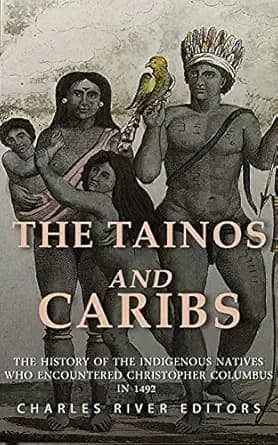
The Tainos and Caribs: The History of the Indigenous Natives Who Encountered Christopher Columbus in 1492
Early CivilizationRead for free with Kindle Unlimited membership
Added on February 15, 2026
Description
*Includes pictures *Includes a bibliography for further reading *Includes a table of contents
On October 12, 1492, one of the most important “first contacts” of the modern era was made when three ships of Spanish origin approached the island archipelago now known as the Bahamas, cautiously dropping anchor as the captain of the fleet gazed across to what he assumed was the coast of India. According to the popular version of the story, amazed at the sight of ships and men of such unfamiliar appearance, the native people of the island plunged into the clear waters of the western Atlantic, expertly swimming or aboard dugout canoes, and came out to greet the strangers.
In all probability, the meeting was much more cautious and incremental, but the idea that these innocent people, raised in a tropical Eden, might embrace with such open enthusiasm their own destruction is picturesque, and no doubt appeals to contemporary perceptions. By whatever means one might choose to view it, this meeting of cultures certainly did mark the beginning of a bold new chapter in the history of Europe, and the beginning of the end of an ancient race of native people occupying a vast new continent.
The entries into Christopher Columbus’ log as he recorded his first encounters with the indigenous people of the “Indies” are very telling. The island people arrived alongside his ships, offering humble gifts that Columbus described as “parrots and balls of cotton and spears and many other things, which they exchanged for the glass beads and hawks' bells.” These were the Taínos people, or the “Arawaks” as they would come to be known, and Columbus described them as “well built…with good bodies and handsome features.”
This description, while deceptively simple, had a chilling implication, because Columbus was not taking note of these facts out of idle interest but in terms of how best to exploit them. As the natives offered up gifts, and the open hand of friendship, and by implication the freedom of their islands, Columbus remarked simply on their primitive appearance and primaeval technology, and how easy they would be to overcome. He noted, “They do not bear arms, and do not know them, for I showed them a sword, they took it by the edge and cut themselves out of ignorance. They have no iron. Their spears are made of cane. They would make fine servants. With fifty men we could subjugate them all and make them do whatever we want.”
What Columbus wanted in the first instance was gold, and he was quick to observe the small items of gold jewelry worn by his visitors, which alerted him immediately to the fact that there was gold to be found somewhere on these islands. To get to the bottom of it, Columbus would waste no time. Thus, a chain of events was set in motion that would permanently affect Western Civilization, and the Taino and Caribs, as the first two groups of indigenous people to encounter the Spanish, were driven to extinction within a century of Columbus’ arrival. In a sense, that would make them the first casualties of European imperialism in the New World.
The Tainos and Caribs: The History of the Indigenous Natives Who Encountered Christopher Columbus in 1492 examines the culture and history of the indigenous groups, and what happened when they came into contact with the Europeans. Along with pictures of important people, places, and events, you will learn about the Tainos and Caribs like never before.
Reader Reviews
Let this be a stepping stone within many. It's disappointing that the publisher/narrator couldn't go that extra step of making sure that words were pronounced correctly. We have enough resources that can help with that much.
Very informational!I borrowed this book because as a Caribbean islander, I wanted to add Taíno and Carib history into our homeschool curriculum. For now, we don't need anything specific to our island, so this book was perfect. My child also didn't read it all, as some of what's in it isn't age-appropriate, but I highly recommend it to anyone wanting to learn more about the native peoples of the Caribbean islands. I took a star off my rating because of some spelling errors, but overall, it's an e
Pretty good, some out dated infoI am a reconnecting Taino and friends with those who are reconnecting Kalinago. And while this book was very informative and gave me info I didn’t know, there was also some that some Elders who have been passed down oral history and cultural knowledge would disagree with. And if I were to share that information publicly I might get called in by an Elder for spreading misinformation
Price History
More by Charles River Editors
View all →More in Early Civilization
View all →Recommended for You
Based on this book
Arzawa: The History and Legacy of a Forgotten Ancient Kingdom in Anatolia
Same author
Target Practice Mysteries 1 & 2 (Target Practice Mysteries Boxset)
Dial P For Poison (Movie Club Mysteries, Book 1): An Irish Cozy Mystery
Top 10 Reasons to Read the Bible Today: The Life-Changing Benefits of Daily Bible Reading (Bible Reading Guides Book 5)
Alien Kid
Under the Light of the Italian Moon: Inspired by a true story of love and women’s resilience during the rise of fascism and World War II
The Trespasser (Amish Country Brides)
Here After