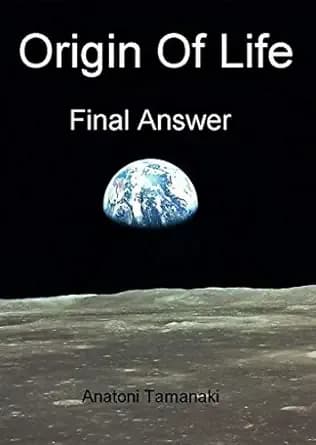
Origin of Life - Final Answer
Cell BiologyRead for free with Kindle Unlimited membership
Added on February 8, 2026
Description
Despite decades of dazzling advance in science and technology the answer to the origin of life is as elusive as ever. It’s time to look at the issue in a new light. The key to solve this mystery is to know the true identity of our earth, whether it’s just a rock sitting in space for lives to inhabit or is it actually a unique kind of a living system. Is it Gaia and sentient? Does it have eyes or ears or a brain? Is it a plant or an animal, or something else? Once the true status of earth is revealed, not only can the question of life’s origin be answered, we can also find out the reason for our human existence, the purpose of the universe and more. This book is the ultimate answer to an ultimate question. There will not be another answer.The first chapter describes the striking similarities between a living cell and earth with humans acting as the information carrying genes of this planetary cell. Further evidence to support such a claim is the significance of tools and machinery humans make as compared to the proteins and enzymes cell genes manufacture.Together with an atmosphere that acts as its membrane, our planet can now fulfill the definition of a living cell. By knowing the true identity of our planet, the chicken or egg puzzle can now be solved.Chapter 2 and 3 use earth and a living cell as reference to explain the role of human and the purpose of the universe. Because of our ability to look into the human activities, how evolution can happen in the cellular world other than a simple chance mutation and natural selection can be answered; and by looking into the history of the cellular world, we can also find out how humans can conquer the stars and even distant galaxies.Chapter four describes the fierce debate of a world of both order and disorder among scientists. It exposes the fallacy of science attempting to use an open system and a cellular structure to explain life's peculiar behavior in the face of a world of randomness and chaos.Chapter five solves the puzzle of the mystery of life's origin. It reveals life did not originate from earth but in reality is developing in stages starting at the beginning of the Big Bang. Earth as a living cell and human as its genes is solid proof how this happens as is explained in this chapter in details. With the cellular world as one of the stages and now earth as another, there will be more to come.In the final chapter, it demonstrates how life is building up orders in this universe by using randomness and even chaos. It explains that life and the universe exist hand in hand together and survive on a nuclear or partnership existence and because of their co-existence, it solves the mystery of how our fine tuned universe can be so life friendly. The question of how a universe can be both order and disorder at the same time can also be answered. This last chapter reveals exactly what the meaning of life is and how to use one sentence to define life and this universe. This book is written in everyday common language but be forewarned, materials and evidence presented in the chapters are revolutionary and unique and at times they can be explosive and jaw dropping. Your world view and your life's outlook will change.
Reader Reviews
It is hard to understand how someone, Anatoni Tamanaki in this case, can write a book about a subject about which he or she has so little knowledge. I am not a genius and I have not yet written my book. What I can tell you is that after reading hundreds, no, thousands of books over my 82 years on this planet, I am certain that I have never read any author who knew so little about the subject that he or she was trying to expound upon. Please, save yourself the agony of wasted time and trust me, t
Essentially a version of (or similar to) the Gaia Hypothesis, so that this is a book about how the totality of reality is (or ‘is like’) a living entity. The book meanders meditatively and ponderingly through a lot of questions and ideas, with the author firing ideas in many directions. That makes it a harder read than necessary, as readers need to sometimes distil a mass of ponderings, to try and work out what the core claims actually are.Those claims include a lot of assertions, such as ‘Intel
I attempted to read through this book and finish. I began this book on the hope of learning about the origin of life, like the book title hints at. However I quickened surmised that this was more to do about the universe, the cosmos. I tempered my expectations and flexed my mind in the that direction. I was quickly dismayed by the observation needed a better edit. This book was obviously a translation, a primitive translation at that. The book was understandable but the poor editing job was jarr
Recommended for You
Based on this book
Alien Kid
Under the Light of the Italian Moon: Inspired by a true story of love and women’s resilience during the rise of fascism and World War II

The Trespasser (Amish Country Brides)

Here After

Target Practice Mysteries 1 & 2 (Target Practice Mysteries Boxset)

Dial P For Poison (Movie Club Mysteries, Book 1): An Irish Cozy Mystery

Secrets: Web of Sin One: Sparrow Webs 1

Breathless In Love (The Maverick Billionaires, Book 1)