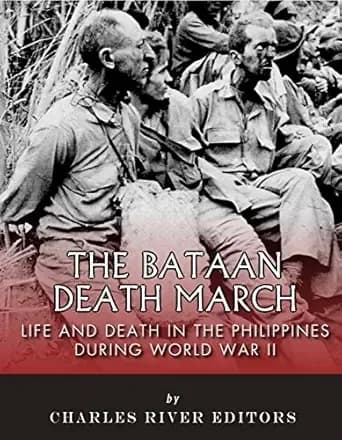
The Bataan Death March: Life and Death in the Philippines During World War II
20th CenturyRead for free with Kindle Unlimited membership
Added on March 22, 2026
Description
*Includes pictures*Includes prisoners' accounts of the death march and prisoner camps*Includes a bibliography for further reading*Includes a table of contents"They went down by twos and threes. Usually, they made an effort to rise. I never can forget their groans and strangled breathing as they tried to get up. Some succeeded. Others lay lifelessly where they had fallen.. I observed that the Jap guards paid no attention to these. I wondered why. The explanation wasn't long in coming. There was a sharp crackle of pistol and rifle fire behind us.” – Captain William DyessOn December 7th, 1941, the Japanese military engaged in a preemptive strike against the American Pacific fleet stationed at Pearl Harbor, but they also began maneuvers to attack the American controlled Philippines. Although General Douglas A. MacArthur and Allied forces tried to hold out, they could only fight a delaying action, and the Japanese managed to subdue all resistance by the spring of 1942. However, in the aftermath of Japan’s successful invasion, as the nation’s military strategists began preparations for the next phase of military actions in the theater, their forces had to deal with a critical logistical problem they had not foreseen. The Japanese had to deal with large numbers of Filipino and American soldiers who had surrendered after a lengthy defense in the Bataan peninsula, but they were not prepared for so many prisoners of war because their own military philosophy emphasized rigid discipline and fighting until the end. They could not imagine a situation in which Japanese soldiers would willingly surrender, so they assumed that no other combatants would do so either. Although the Bataan Death March would become synonymous with brutality and are still widely viewed as an atrocity, Japanese plans called for an orderly removal of the prisoners by foot, truck and rail into central Luzon so that they could quickly use Bataan as a launching point to attack the island of Corregidor, thus clearing the entrance to Manila Bay and gaining a key location for naval operations in the Pacific. In fact, Japanese plans did not call for any sort of brutality toward the prisoners; orders coming down from military leaders described potential interactions between Japanese soldiers and POWs as occurring with a “friendly spirit.” The atrocities that occurred during the Bataan death march were instead due to poor planning and the brutality of individual Japanese soldiers who themselves were harshly treated within the Japanese military regime and did not understand soldiers who surrendered. In conjunction with that, an inability or unwillingness on the part of Japanese commanders at Luzon, and especially by General Masaharu Homma, to act against the suffering of Filipino and American POWs led to the harsh conditions of both the march out of Bataan and the experience within Japanese internment camps. In terms of the death toll, an estimated 9,000 Filipino and 1,000 American prisoners died during the march alone. For the Pacific Theater as a whole, 37% of all prisoners of war died while in captivity. At the conclusion of the war, a war crimes tribunal found the Japanese officers in charge of prisoner-of-war operations in the Philippines guilty. Most notably, General Homma was found guilty of crimes against humanity, and on April 3, 1946, he was executed by firing squad near Manila. Several other Japanese military officials were also found guilty by the tribunal and executed for their roles in the treatment of American and Filipino prisoners of war. The Bataan Death March chronicles the horrific trials and tribulations experienced by the prisoners of war. Along with pictures of important people, places, and events, you will learn about the death march like never before, in no time at all.
Reader Reviews
I enjoyed the style of writing, and there were even real accounts from men who had survived the death march. Even so, the death march event was bad. But the author did really well with writing this book.
This was hard to read as the topic is sad, gross, and horrifying. Yet, it is important to remember what some people suffered and that war is not a pretty thing.
Very short and less about the actual march and more little vignettes about the march, the camps, being rescued and then reacclimation. Useful only for an initial view of the horrors of the Philippine POWs of both the Flipinos and Americans, but there are better books and ones with more information or a better plot than this one.
Price History
More by Charles River Editors
View all →More in 20th Century
View all →
Recommended for You
Based on this book
Arzawa: The History and Legacy of a Forgotten Ancient Kingdom in Anatolia
Same author
Alien Kid

The Box

Under the Light of the Italian Moon: Inspired by a true story of love and women’s resilience during the rise of fascism and World War II

The Trespasser (Amish Country Brides)

Here After

Target Practice Mysteries 1 & 2 (Target Practice Mysteries Boxset)

Dial P For Poison (Movie Club Mysteries, Book 1): An Irish Cozy Mystery