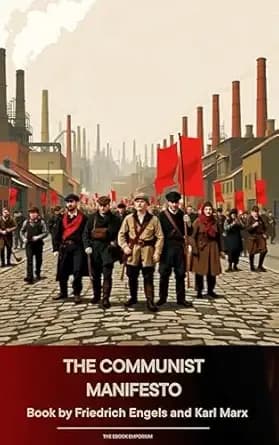
The Communist Manifesto
Communism & SocialismAdded on January 15, 2026
Description
"A spectre is haunting Europe—the spectre of communism."In a world transformed by the Industrial Revolution, Marx and Engels set out to decode the hidden mechanics of society. They argue that all of human history is the history of class struggles: the constant friction between those who own the means of production and those who sell their labor to survive. The Communist Manifesto is a call to action that envisions a future beyond exploitation, predicting the inevitable rise of the working class and the transition to a classless, stateless society. Whether viewed as a historical artifact or a living critique of global economics, this text remains essential for understanding the modern world.The Great Divide: Bourgeoisie vs. Proletariat: The Manifesto famously defines the two warring camps of the industrial age. The Bourgeoisie (the ruling capitalist class) are described as a revolutionary force that "shattered" feudalism but created a system of "naked self-interest." Opposing them is the Proletariat (the working class), whom Marx describes as the "grave-diggers" of the very system that created them.The Ten-Point Program: In the second section, the authors lay out a controversial and radical set of measures for the "most advanced countries," including the abolition of private land ownership, a heavy progressive income tax, and the centralization of credit and communication in the hands of the state. These points sparked over a century of political experimentation and debate across every continent.A Legacy of Global Change: From the revolutions of 1917 to the modern labor movements of the 21st century, the rhetoric of the Manifesto has been used to challenge the status quo. Its closing cry—"Working Men of All Countries, Unite!"—remains one of the most famous slogans in human language, symbolizing the birth of international political solidarity.Analyze the roots of the modern world. Purchase "The Communist Manifesto" today.
Reader Reviews
With a profuse beard, a Beethovenian hairstyle, a knack for well-chosen demonstrations and ground-breaking political ideas, Karl Marx was (still is) an idol. And The Communist Manifesto, although extremely short (alongside Das Kapital, which is extremely long), is one of the most influential texts in Western history, probably on par with the Gospels. Indeed, there is (still is) the same sort of bigotry and anathema around Marx, the same dogmatism and heresies, the same confrontations and bloodsh
Long overdue update (2013): I read this book five years ago and in almost every respect, I have mellowed considerably.You can read my review below. It's unchanged. You can read the comments below that. Also unchanged.I never seriously expected anyone to read this review, much less love or hate it so strongly. I am not apologizing for my view of the book or Marx. He put his entire life into this slender and influential book, and I respect that. I understand a bit more about where he was coming fr
Communism doesn’t work. Its ideals are perfectly understandable, justifiable even, but the way it seeks to attain them, that’s just terrible. In reality communist policy falls apart or isn’t fully followed. The driving force is to achieve a classless rather than class based society. Sounds good on paper doesn’t it? But in order to achieve such a thing, the manifesto proposes a revolution that will wipe out private property. This is more than following the march of history. Mankind has seen count