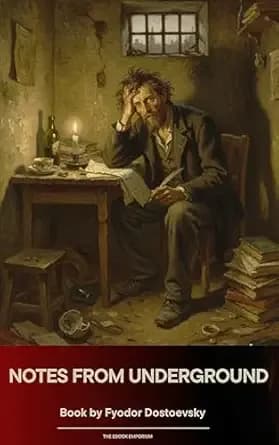
Notes from Underground
ClassicsAdded on January 11, 2026
Description
"I am a sick man... I am a spiteful man. I am an unattractive man."From the dark, damp recesses of a crawlspace in St. Petersburg, a retired civil servant launches a scathing attack on the modern world. The "Underground Man" is one of literature's first and greatest anti-heroes—a man who chooses to be miserable, spiteful, and irrational simply to prove that he is free. In a world obsessed with logic, progress, and "enlightened self-interest," he stands as a disturbing reminder that human beings will often destroy their own happiness just to assert their individuality.A War Against Rationality: The Underground Man's primary target is the "Palace of Crystal"—a metaphor for a perfect, scientifically organized society where all human needs are met. Dostoevsky argues that such a world would be a prison. Through his protagonist's chaotic internal monologue, he asserts that man's "most advantageous advantage" is the freedom to act against his own interests, even if it leads to suffering.A Tragic Human Encounter: The second half of the book moves from philosophy to a painful, cringe-inducing narrative. We see the Underground Man in his youth, attempting to assert power over his former schoolmates and the vulnerable prostitute, Liza. These encounters reveal the true tragedy of the "underground": the paralyzing self-consciousness and vanity that make it impossible for a man to love or be loved.The Mirror of the Modern Mind: Notes from Underground is a bridge between the classic novels of the 19th century and the modernist masterpieces of the 20th. It is a raw, uncomfortable, and essential read for anyone who has ever felt at odds with the "logical" flow of society. It is a scream from the depths of the human spirit that still resonates today.Dare to look into the underground. Purchase "Notes from Underground" today and confront the darker side of freedom.
Reader Reviews
More than anything, this book should make you think. And not about trivial shit either, but about big, important conditions of life and how best to view and react to them. I have "should" italicized in that first sentence for a reason: If you don't give yourself time to think -- if just skim through the book quickly -- then you won't get anything out of it. It's narrated by a guy living underground, in poverty. You are reading his notes. The first half, his ramblings, thoughts and philosophies o
Imagine 19th century Russian literature as a loud boisterous party. Here's Pushkin, basking in the center of attention, charming up all the ladies. Here are Chekhov and Gogol at the heart of a passionate intellectual argument. Here's Count Tolstoy, busily serving canapés while rejoicing in the pleasure of work, stopping only to chat about the pleasures of countryside with Turgenev. But where's Dostoyevsky? Oh, there he is, sitting by himself in a dark corner, dead broke after a high-stakes cards
As I burrowed anxiously into Fyodor Dostoevsky’s underground rant when I was eighteen, I was suddenly mushrooming in stature far beyond my pay scale. How do you explain it to your senior year preppie-ish friends that you’re suddenly beyond them? You’re like Alice in the rabbit hole. I had been a bullied suburban kid, and now I was being harried by absurd abstractions.And justifying it - by labelling it smart - but sotto voce, so no one heard me.All my life, you see, my thoughts and emotions had