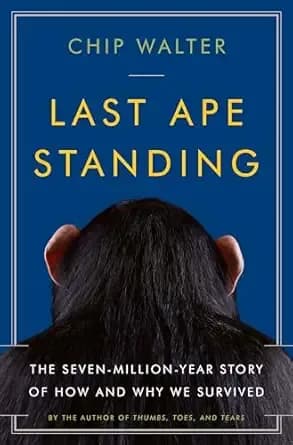
Last Ape Standing: The Seven Million Year Story of How and Why We Survived
by Chip Walter
PrehistoryRead for free with Kindle Unlimited membership
Added on February 8, 2026
Description
Over the past 150 years scientists have discovered evidence that at least twenty-seven species of humans evolved on planet Earth. These weren't simply variations on apes, but upright-walking humans who lived side by side, competing, cooperating, sometimes even mating with our direct ancestors. Why did the line of ancient humans who eventually evolved into us survive when the others were shown the evolutionary door?Chip Walter draws on new scientific discoveries to tell the fascinating tale of how our survival was linked to our ancestors being born more prematurely than others, having uniquely long and rich childhoods, evolving a new kind of mind that made us resourceful and emotionally complex; how our highly social nature increased our odds of survival; and why we became self aware in ways that no other animal seems to be. Last Ape Standing also profiles the mysterious "others" who evolved with us-the Neanderthals of Europe, the "Hobbits" of Indonesia, the Denisovans of Siberia and the just-discovered Red Deer Cave people of China who died off a mere eleven thousand years ago.Last Ape Standing is evocative science writing at its best-a witty, engaging and accessible story that explores the evolutionary events that molded us into the remarkably unique creatures we are; an investigation of why we do, feel, and think the things we do as a species, and as people-good and bad, ingenious and cunning, heroic and conflicted.
Recommended for You
Based on this book
The Near-Death Experience of Justin Parks
Dragonskull: Sword of the Squire
Alien Kid
Under the Light of the Italian Moon: Inspired by a true story of love and women’s resilience during the rise of fascism and World War II

The Trespasser (Amish Country Brides)
Here After

Target Practice Mysteries 1 & 2 (Target Practice Mysteries Boxset)

Dial P For Poison (Movie Club Mysteries, Book 1): An Irish Cozy Mystery